
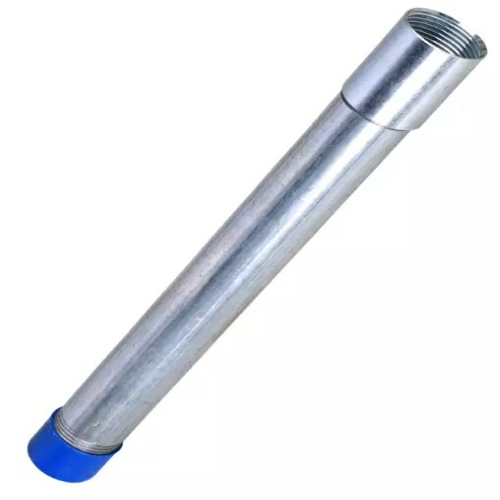
Galvanized Iron Conduits are rigid and flexible conduits used for various commercial and household applications. These GI Conduits have a long life expectancy of about 50-70 years. However, these conduits' life span depends on air and water contaminants. GI pipes' life span also varies on the thickness of the zinc coating applied on the pipe.
| Size in MM | Ext. Dia (mm) | Tolerance in Ext. Dia | Thickness |
| 20 | 20 | -0.3 | 1.4 to 1.8 |
| 25 | 25 | -0.4 | 1.4 to 1.8 |
| 32 | 32 | -0.4 | 1.4 to 1.8 |
| 40 | 40 | -0.4 | 1.6 to 2.2 |
| 50 | 50 | -0.5 | 1.6 to 2.2 |
In the installation of electrical equipment, conduit pipes are used for the protection of electrical cables. Mainly three types of electrical pipes are used in electrical construction. GI, Flexible Metal and PVC are the three types of electrical conduit pipes. For the installation of PVC pipes, copper and glue is mainly used. However, for installing the GI Conduit Pipes, a GI vendor machine and wrench are used.
GI Conduit Introduction
What Are the GI Conduit Uses?
- Transportation of Water and Sewage
- Structural purposes
- Electric Poles
- Transmission of Oil and Gas
- Engineering purposes
- Automotive purposes
- Compression of Air Lines
- Fire Fighting Equipment
- Air Ducts
Features of GI Conduit
Galvanized iron pipes and their attachments offer many high durability and flexibility features. However, the main features of GI pipes include the following:
Protection Against Fire
Galvanized iron pipes protect against fire because they are flame resistant. These conduits are entirely halogen-free and do not produce any toxicity or smoke. In addition, GI pipes have a very limiting oxygen index, which means they do not catch fire or smoke quickly.
Mechanical Strength
Galvanized iron provides a higher tendency to pain, which directly reduces the risk of rusting. Therefore, these GI pipes are ideally the perfect choice for water-supplying pipelines as they are more prone to rusting. Moreover, GI conduits can also easily withstand all the other physical forces.
Highly Flexible
Galvanized iron also comes with a high degree of elasticity, decreasing the chances of breakage. This also ensures that the transfer of water, wire or cables will be smooth. However, these pipes have a stronghold in the market because of their stronghold and flexibility.